Before I ever set foot in Scotland, I had already written about it.
That probably sounds strange, but by the time I finally visited the Scottish Highlands, part of The Journey to the Left Side was already set there.
My connection to Britain began long before that. I spent five years living in the United Kingdom, studying in London and travelling whenever I could.
Long before I moved there, I knew that was where I wanted to be. I was fascinated by British culture, literature, history, and the English language itself.
Looking back, many of the things that shaped me as a reader and writer came from there.
My love of Jane Austen, the Brontë sisters, Harry Potter, Celtic culture, druids, and even my obsession with the Regency era all have their roots in that fascination.
By the time I started writing my novel, Britain already felt familiar. It felt like home.
And yet Scotland remained the place I knew mostly through books, maps, documentaries, and endless research.
My novel is a very geography-driven story. Continents, tectonic plates, fault lines, and landscapes play an important role in the worldbuilding.
While researching, I discovered the Great Glen Fault, a geological fault line that cuts through the Scottish Highlands from Fort William to Inverness. The moment I saw it on a map, something clicked.
A fault line dividing a landscape in two felt like exactly the kind of place where part of my story belonged.
So I wrote about it.
I wrote about the Highlands before I had ever seen them.
I wrote about the valleys, the rugged landscapes, and the atmosphere of a place I knew only from research and imagination.
I relied on everything I had learned while living in Britain and everything I loved about its landscapes and history.
The more I wrote, the more certain I became that this part of the story could only happen there.
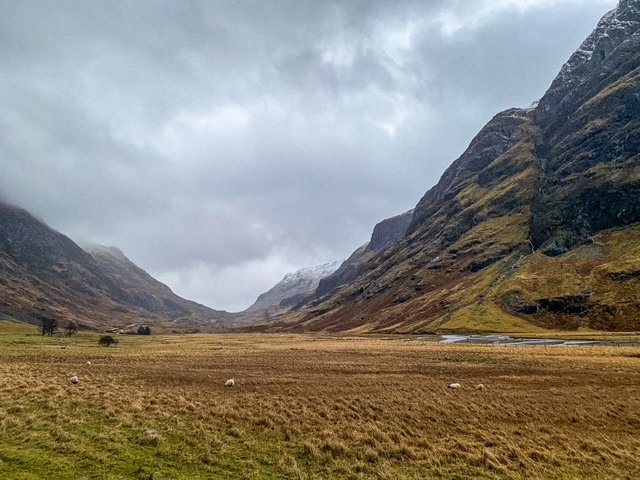
Then, about a year later, I finally went to Scotland. I drove through Glencoe and towards Fort William, arriving at the beginning of the Great Glen.
And I cried.
Not because it was different from what I had imagined. It wasn’t.
I remember standing there, looking at the landscape that had existed in my head for so long, and struggling to believe that I was finally seeing it with my own eyes.
I had written about this place from another country. And now I was standing in it. It felt surreal.
It felt as if a place that had lived in my imagination had suddenly become real.
During the same trip, I visited Edinburgh and stopped outside The Elephant House, the café famously associated with J. K. Rowling’s early work on Harry Potter.
Of course I touched the door handle. It felt completely necessary. Standing there, I thought very clearly: If she managed to do it, maybe I can too.
For someone who grew up loving Harry Potter, that moment meant more than I can properly explain.
But Scotland inspired my fantasy world for reasons that go beyond books.
There is something about the atmosphere of the Highlands, the landscapes, the moors, and the feeling that the land itself remembers stories.
Even before I saw them in person, I was fascinated by heather-covered landscapes. As a child, I first encountered them in Tove Jansson’s Moomin books, another major source of inspiration throughout my life.
I remember reading about heather moors and wondering what they actually looked like. Where I grew up, there was nothing quite like them. The very idea felt mysterious and distant, like something that belonged to another world.
When I finally stood among them myself, they felt strangely familiar. As if I had already been there.
Perhaps that is why Scotland became part of my fantasy world.
Not because it felt magical.
But because it felt real enough to believe in.
And sometimes, for a fantasy writer, that is more than you can actually hope for.